

Sullivan's Mirror
Andrew Sullivan blames the trans wars for the erosion of same-sex marriage support. The mirror tells a different story.

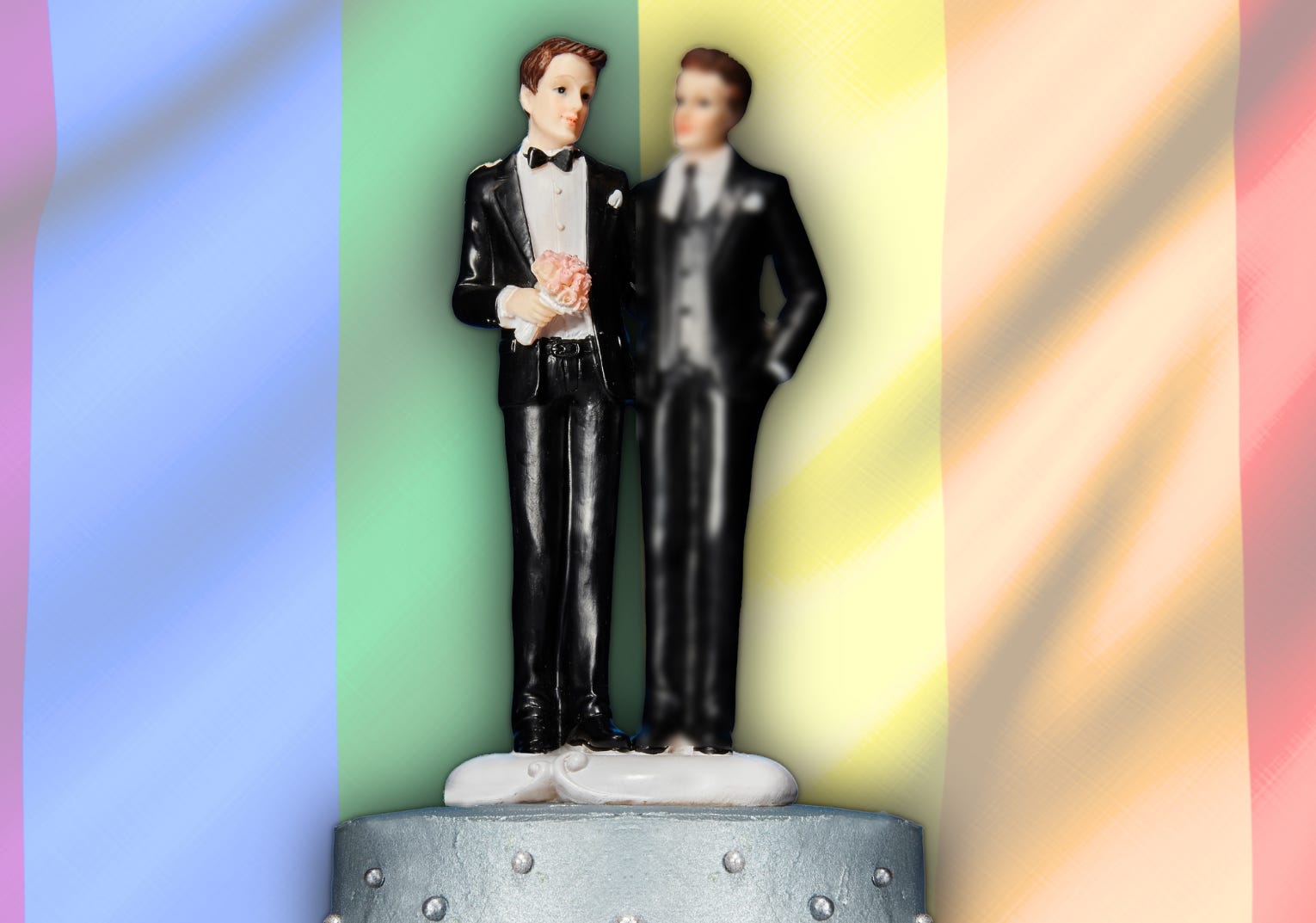
As we enter Pride Month eleven years after marriage equality, we should not expect to see what was absent during last year's milestone tenth anniversary. Don’t expect parades, festivals, op-eds celebrating marriage equality, or scenes of couples lining up to exchange the vows we fought so hard for, or Sunday sermons preached on marriage equality by the churches that fought for it alongside us.
Instead we are greeted by news that public approval of same-sex marriage, and of gays and lesbians generally, continues to erode. Sixty-five percent of Americans today favor same-sex marriage, compared to 71% approval in 2022. Among Republicans, support has nose-dived from 55% in 2022 to 37% today. Adding insult to injury, the proportion of Republicans who believe that "gay and lesbian relations… is morally… acceptable" has fallen 21 points to 35%. According to Gallup,
“Republicans’ views of the morality of same-sex relations are now similar to what they were between 2005 and 2014.”
What happened?
Within the LGBTQ community you will hear two different explanations. (Both are wrong.)
Activists and their progressive supporters (those who champion the "T" and the "Q" of the community) will tell you it is hatred and bigotry on the American right that never went away and is rearing its ugly head in our divisive politics. For many activists, the hatred and bigotry is evidenced by rejection of the non-binary view of gender and opposition to the transgender policy agenda, including "gender-affirming care." Or, as an online activist describes in a popular meme, transgender people are the real victims in this struggle and gays and lesbians are likely to be caught up in the same wave of hatred.
On the other side, people like Andrew Sullivan, say it’s the promotion of the trans agenda that is alienating Americans. According to this view, it is the radical agenda of "trans-ing children" and the participation of transgender persons in sports that is causing a backlash against our marriages. Here is how Sullivan summarizes the new agenda of the LGBTQ community around queer identity:
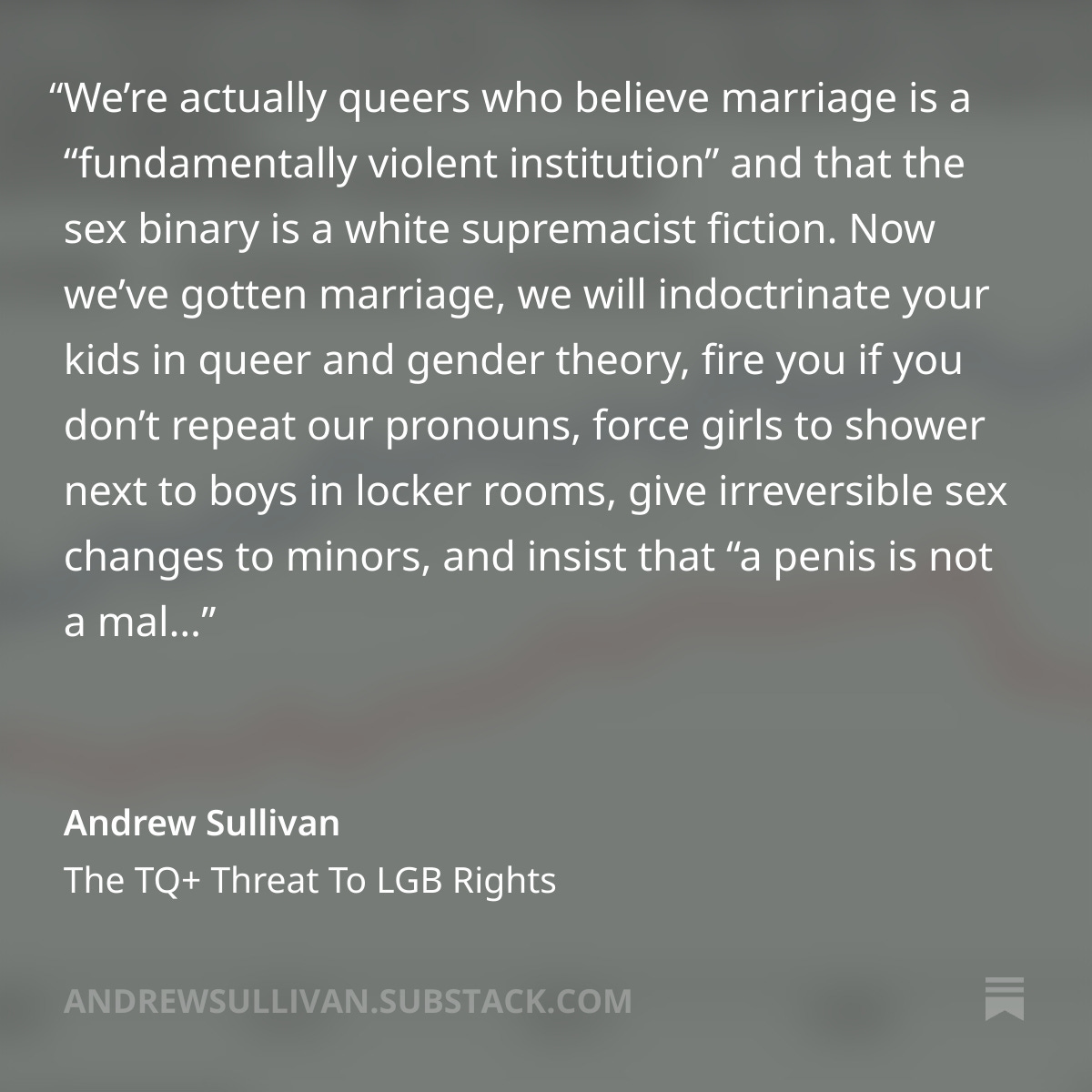
Notice that both explanations have changed the subject. The activists of the alphabet-soup community and their critics may presume that Americans lump all the groups together, but most Americans would struggle to connect the dots between bathroom laws and gay marriage. Ironically, both Sullivan and the activists he criticizes share the same assumption: that public attitudes toward gay marriage are inextricably linked to public attitudes toward transgender issues.
That said, I too am concerned that the radicalization of advocacy groups and activists who claim to speak on our behalf (gay, lesbian, and bisexual Americans). When the Mayor of New York City chooses to refer only to “queer and trans people” when referencing me and other gay, lesbian, and bisexual Americans, we should object. Lumping gay and lesbian Americans into a category named after a slur is offensive, but it also could be seen as creating a buffer between the “normie” gays and those who champion fringe issues. As Sullivan referenced, only 6 percent of “sexual minorities” identify themselves as “queer.” The fringe issues and tactics of a tiny minority within a minority cannot hold enough explanatory power for the decline in support for same-sex marriage.
Indulge me with this provocative notion: perhaps Americans (including Republicans) are assessing same-sex marriage based on what they know or believe about… same-sex marriage.
To explain the erosion in same-sex marriage support, Sullivan pointed to a colorful array of the worst and most transgressive countercultural positions and tactics of queer activists. The backlash against these radicals, in his telling, is the wave we have fallen victim to. What he failed to invoke is the countercultural position more directly relevant to that erosion, and it is a position he himself has championed for over a decade.
In a 2004 interview, Sullivan insisted that gay couples were not trying to redefine marriage but to join its “core tradition of mutual devotion,” and he described the push for gay marriage as “a development in favor of the ideas of fidelity, of love, of commitment, of monogamy.” This was the case we made to right-leaning Americans; this is the case that won them over. Eight years later, three years before Obergefell, Sullivan published “The Future of Promiscuity” in The Dish, in which he entertained the notion of “dignified promiscuity,” argued that “gay male marriages may require some discreet adjustments as time goes by in order to keep the union alive and healthy,” and speculated that gay couples might “lead the way in resuscitating [marriage] for the 21st Century” precisely by loosening the expectation of sexual exclusivity.
The countercultural position most relevant to the erosion we are now witnessing is not on Sullivan’s list of provocations because it is Sullivan’s own.
When we argued for gay marriage to the same right-leaning Americans who have been souring on the issue as of late, what did we say? What did we promise? Did their support hinge on our views of transgender people playing soccer or our promise to oppose puberty-blockers for children who believed they were a different gender? Of course not.
To win over the hearts and minds of Americans whose votes and approval we needed, we promised to honor the institution and the obligations it demands.
Instead, a 2023 Pew survey found that 75% of lesbian, gay, and bisexual Americans say an open marriage is an acceptable arrangement for people to have. Among straight Americans the figure is 29%. Among Democrats overall, 47%. Among Republicans, 20%. Among Americans over 65, 15%. There is no demographic in the country that treats monogamy as optional at anything close to the rate we do.

Americans are not reading Pew crosstabs. They are watching how we live. They are watching the gay couples on reality television whose marriages seem always to serve as backdrop for affairs. They are reading the advice columns that treat monogamy as an option to be negotiated with your spouse, not an actual vow. They are hearing the discussions of “ethical non-monogamy” and “polyamory” that have become unremarkable in coverage of the LGBTQ community. And they are doing what people always do with cultural signals: drawing inferences about what an institution means to those in it by the way its members treat it.
No survey can tell us precisely why support for same-sex marriage has declined. But we do know the argument that won Americans over; the one that moved opinion in the first place. We assured them that marriage would mean the same thing for us that it meant for them. If many Americans no longer believe that is true, it would help explain why support is eroding.
We asked Americans to judge same-sex marriage not by our desires but by our vows. We assured them that marriage would mean the same thing for us that it meant for them. That, not bathroom laws and not trans athletes, is the audit now underway. Eleven years later, the audit is going badly.
The institution we asked them to extend to us is being held differently than they were promised.

I am as straight as an arrow and not particularly invested in this debate. Sorry for stating the obvious but 1/ is there any difference between straight and gay men in the number of extra-marital affairs? and 2/ do you have any data backing up your view that rejection of gay marriage would be linked to the extra-marital affairs of gay couples?
I have another explanation: there is a great ideological sorting taking place both on the left and the right leading to the “omnicause” and gay marriage is becoming part of that. I would argue that to avoid this, if it is in fact possible, gays and lesbians need to reject the TQ and all the attendant folklore such as rainbow flags and Pride and become part of a SLGB non-movement. - “S” being “straight” of course.
Where do you actually hear people citing monogamy as the reason they're reconsidering support for gay marriage? I've seen LOTS of folks commenting along the lines of, "We supported gay marriage because...but then..." Yet what follows is inevitably a discussion of the excesses of QT+ wokism and down-your-throat commercialized Pride, with the most consistent specific objections all having to do with kids.
We made a lot of arguments about wanting normal marriages, but we also swayed a lot of fence-sitters by pointing to the foibles of heterosexuals. It's difficult to argue against gay marriage when divorce and extramarital sex are so prevalent among straights. Normie straights may not approve of non-monogamy, but neither do they want to make hetero non-monogamy illegal (again.) I saw many conservatives over the past 20 years say something like, "I think marriage should be this, but that ship has sailed."
I can't think of ever having seen someone for whom monogamy was the hinge on which their opinion of gay marriage swings. The utterly understandable issue at the moment is how much the QT+ crowd has plowed past heterosexual foibles into sincerely offensive, intolerant and downright creepy territory, especially around kids.